
by Tina Wiles

You know that you have things that need to be done. Maybe you are feeling overwhelmed? Do you keep listing out (either in your head or on paper) about everything that you need to study? Does one thing make you think of another thing you need to do? This is called spiraling.
It is Monday night. Tuesday you have a paper due and a quiz. Wednesday you have a test in another subject. You have a group project that is due next Monday, but nothing has been done on it yet and no one is committing to when they can meet. You have an hour that you can work on your paper before you have a commitment, and the last thing you want to do is sit down to study.
Or maybe it looks like you have a huge project you are working on at work and according to the schedule you made for what to cover as you prepare for your test, you are over a week behind where you wanted to be. You have things that need to be done for work and home. You got home late from work, and you have an hour left in the time you set aside to study for your exam, and the last thing you want to do is sit down to study.
What you WANT to do (anything but studying) and what you NEED to do (studying) aren't matching up. (Spoiler alert, this happens outside school like all the time too!)
If this is your pattern every time you sit down to study, you might be what I call The Avoider. It's not laziness. It's not a character flaw. It's your nervous system trying to protect you from something that feels too big to face. The good news? There is a way through it.
Story time.
This was me this past week. I had several things that I needed to do but I was stuck in the spiral and couldn't make myself do the things that I needed to do. Luckily, I practice what I teach, so I just had to remind myself of what I would tell someone if they were spiraling.
What Actually Works
All of this advice is taken from many different sources over the years thrown in with some things that help me. Here's what I walked myself through last week, and what I'd walk you through too.
1. Stop the spiral
When things feel like they are making you spin and you can't catch your breath, that is exactly what you need to do. Stop and breathe. Tuning into your breath and taking it out of autopilot is the fastest way to bring you into the present moment. In the present moment, you just need to inhale and exhale.
I've given several examples of breathing techniques in other blog posts, but today I will talk about Box Breathing.
Inhale through your nose for a count of 7 (try to breathe all the way down into your stomach)
Hold at the top of your breath for a count of 7
Exhale through your mouth for a count of 7 (like you are blowing out through a straw)
Hold at the bottom of your breath for a count of 7
Repeat 4 times
2. Recenter
Honestly, I have found that how long it takes to recenter is different person to person, but also event to event. I can recover in less than a minute in some situations, while other situations may take a full day.
The thing that helps me the most with recentering is meditation. I use an app called Insight Timer (which is free), but you can even go on YouTube to search for a guided meditation. I find that when I meditate, I am able to calm all of the things that are swirling around me.
Nature can also help. Going for a walk and admiring nature can help you recenter and calm down. The natural rhythm of nature itself, water flowing down a stream, leaves rustling in the wind, the sound of birds chirping, can help your nervous system go back to its normal state.
Tapping into your creative side works too. Singing, dancing, crocheting, drawing, painting, whatever your jam is. Being creative is a form of meditation called "active meditation" because you get into a state of flow and deep focus, which is what can help center you.
3. Reframe
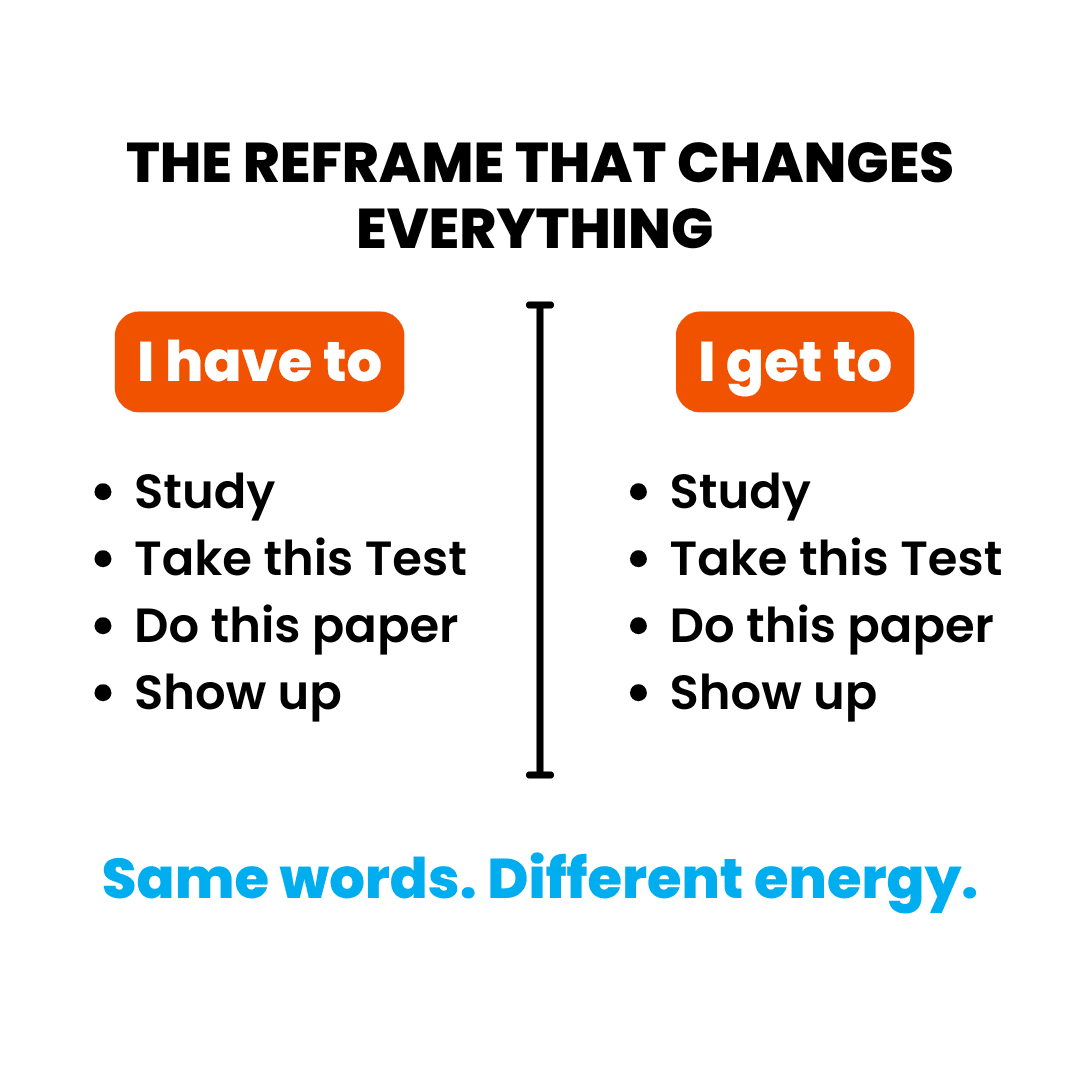
Last week, this idea came to me in a meditation (I told you I practice what I preach, lol) and it helped me so much. I realized that I use the phrase "have to" A LOT. I have to do this. I have to go to that meeting. I have to talk to so-and-so. I have to study.
Listen to how that phrase feels in your body. "I have to" is heavy. It's a weight. It's an obligation. It makes everything feel like a burden someone is putting on you, and your brain rebels against it. That's part of why you can't make yourself study. Your nervous system is reacting to the pressure of "have to" before you even open the book.
So I started swapping it. Instead of "I have to study," I tried "I get to study."
I get to prepare for this exam because passing it opens a door I want to walk through. I get to work on this paper because I'm building toward something. I get to study because this is a path I chose, and not every door is open to everyone.
I'm not going to tell you it works every single time. But it works often enough that it changes the energy you bring to the work. And the energy you bring to the work is everything.
Try it the next time you catch yourself saying "I have to." Pause. Switch it to "I get to." Notice what happens.
4. Brain dump
Set a timer for 5 minutes and write down EVERYTHING that you have in your brain. All of the to-do's. All of the things you are worried about. The big stuff, the small stuff, the stuff that's been nagging you for weeks. Get it all out of your head and onto paper.
Here's why this matters. Your brain is not a storage device. It's a processor. When it's holding 47 open loops, it doesn't have the bandwidth to actually focus on the one thing in front of you. Brain dumping closes the loops, or at least sets them down for a minute, so you can think.
5. Prioritize
Now look at your list. I know it feels overwhelming. That's okay.
You're not going to do all of it tonight. You're going to do ONE thing.
Circle the one thing on that list that, if you did it in the next hour, would make you feel the least behind. Not the most important thing. Not the hardest thing. The one thing that would give you the most relief.
That's your one thing. Everything else can wait until you've done that.
The Avoider's trap is looking at the whole mountain and deciding it's not climbable. The way out is picking up one rock.
6. Start. Just start.
Set a timer for 25 minutes. Open the book. Open the document. Whatever the one thing is, start it.
You don't have to finish. You don't have to do it well. You just have to start.
Most of the time, the resistance is in the starting, not the doing. Once you're 5 minutes in, your brain catches up and you can keep going. But you have to give it those 5 minutes.
So what actually moves the needle?
Not more studying. Not a longer study plan. Not another hour you don't have.
What moves the needle is getting your nervous system out of fight-or-flight so your brain can actually do the work. It's reframing the weight of "have to" into the lightness of "get to." It's clearing the mental clutter so you can see the one thing that matters tonight. It's starting before you feel ready, because you're never going to feel ready.
This is the part nobody teaches you. Everyone tells you to study harder, study longer, study smarter. But if you can't make yourself sit down in the first place, none of that matters.
The work isn't about the material. It's about you.
And you can do this.
Author Bio:
Tina Wiles is a test anxiety expert, ACT/SAT strategist, and Brian Kane Certified Mental Performance Coach with over 20 years of experience helping students and professionals pass high-stakes exams. She is the founder of My2tor and From Panic to Passing. Take the free 2-minute Test-Taking Mindset Quiz at my2tor.com to find out what's really holding you back.
In just 60 seconds, you’ll uncover:
Your dominant test-taking mindset
How stress and pressure affect your performance
Why traditional prep hasn’t fully worked
Which strategies will help you feel calmer and more in control
Get expert ACT/SAT updates, strategy tips, timelines, and parent guidance — straight to your inbox.