
by Tina Wiles
I have a test coming up, so I'm going to figure out everything I need to study, come up with a detailed game plan, put in ALL the work and practice, and walk into the test with confidence.
Then, during the test, I get stuck between answer choices because I'm trying to remember the exact wording from the top right corner of my notes on page 10. I just know I'll figure this out if I read through it one more time. I know this material inside and out. Before moving on, I change my answer at the last second because I remember a similar question I got wrong in practice, so my first instinct must be wrong.
I put in the work. I knew what I was doing. My practice tests proved it. So why does my actual test score not even come close?
Does any of this sound familiar?
If so, welcome to the Overthinker Club. I'm a founding member, but I'm also proof that you can overcome it.
How do you know you're an Overthinker?
Here are five signs that point to the pattern:
1. You're a high achiever who studies extensively. You want to know the material inside and out, and you aren't afraid to put in the time and effort to feel like you've done a good job preparing.
2. You change correct answers to wrong ones. You've gotten a test back and realized you had the right answer before you talked yourself out of it - more than once.
3. You get stuck on hard questions instead of moving on. You just know that if you spend a little more time on it, you'll work it out.
4. You score lower on actual tests than your practice tests suggest. You can't understand why the gap exists. One telltale sign: in school, your final exam grades often pulled your overall grade down.
5. You arrive at test day already exhausted. You used every last second leading up to the test to keep preparing, and by the time you sit down, you're already running on fumes.
These five things share one root cause. You know the material, but you don't trust yourself in the moment.
You're highly capable and often over-prepared, but your mind is constantly spinning. You analyze, re-analyze, and second-guess yourself right out of the correct answer. You fear making mistakes more than you fear not knowing. As a result, you burn mental energy on perfection instead of trusting your preparation.
The good news? There are tools that will help you stop the spinning.
So what can you do about it?
You don't need a different fix for every sign. The Overthinker pattern has one root, and these three tools go after it directly.
1. Trust yourself.
You've heard "trust your gut" before. There's real science behind it. Your gut sends information to your brain, and your body processes information faster than your conscious mind can analyze. When you're stuck between answer choices, your first instinct is often already working with everything you studied.
When you feel yourself spinning between choices, try this three-step reset:
Reread the question slowly, with the intention of "what is this actually asking me?"
Take one slow breath. Inhale through your nose, filling your abdomen with air. Hold for a count of three. Exhale slowly, focused on the temperature of the air leaving your body.
Count down silently: 3, 2, 1. Choose what your gut says, flag the question if you want to revisit it, and move on. (borrowed from Mel Robbins' 5-second rule)
If you have time to come back, you're just confirming your answer, not reconsidering it. If you don't feel confident in your answer but you don't have a clear reason to change it, leave it alone. Changing an answer without a concrete reason is a confidence issue, not a content issue. Trust the work you put in.
2. Separate your self-worth from getting everything right.
You are not a reflection of your test score. It can feel that way when you've poured so much into preparing, but letting a score define your entire sense of self puts enormous pressure on every single question. That pressure is what creates the spinning.
Research on a neurological signal called ERN (error-related negativity) found that people who affirmed their self-worth before a high-pressure task made fewer errors and recovered from mistakes more quickly than those who didn't. Grounding yourself in who you are before the test begins actually changes how your brain performs under pressure.
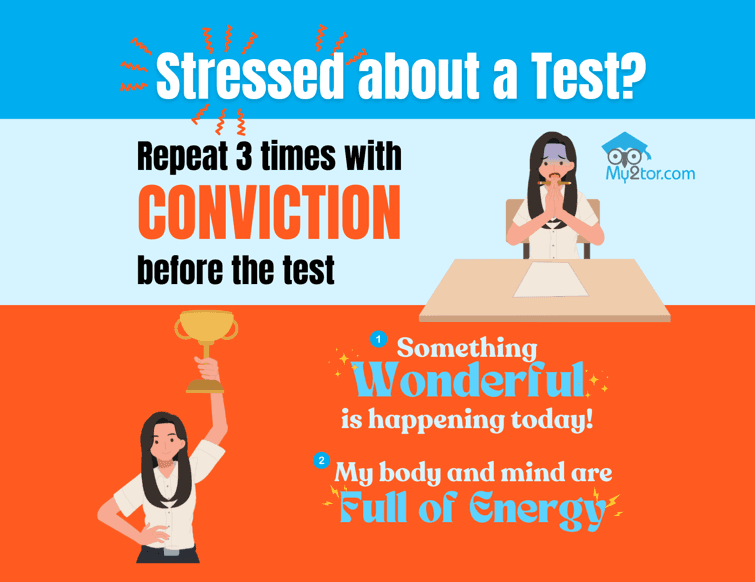
Try these rituals. Before the test, repeat each of these three times with conviction:
Something wonderful is happening today.
My body and mind are full of energy.
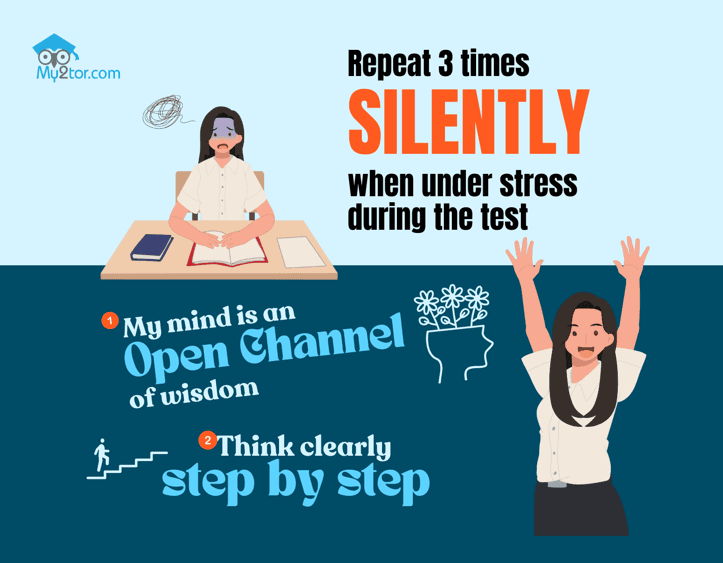
If you feel stress rising during the test, repeat these three times silently:
My mind is an open channel of wisdom.
Think clearly, step by step.
These aren't just feel-good phrases. They're pattern interrupts that signal safety to your nervous system so your brain can do what it already knows how to do.
Another reason I want to share this is because these phrases actually come from my family. My grandmother used to write them on notes and tuck them into my father's lunch on exam days. Now I pass them on to you.
3. Interrupt the overthinking in the moment, not after the test.
When you catch yourself spiraling, say "Stop" to yourself. Out loud if you can, silently if you need to. Re-reading the same question four times? Stop. Frozen and can't move forward? Stop. Mind spinning? Stop.
Then do something physical. Stretch your arms. Roll your neck. Wiggle your toes. It doesn't matter what it is. Movement interrupts the mental loop.
Take a breath, and say something to yourself that creates forward momentum. "Think clearly, step by step." "I've got this." Whatever lands for you.
You're not just taking a break. You're actively stopping the spiral and returning yourself to the present moment, which is the only place where you can actually answer the question in front of you.
You've already done the hard part.
The Overthinker's struggle isn't about what you know. It's about learning to trust that you know it. The good news is that self-trust is a skill, and like every skill on this test, it can be practiced and built.
You put in the work. Now let yourself show it.
About the Author
Tina Wiles is the founder of My2tor and a certified mental performance coach with 20+ years of experience helping students and professionals conquer high-stakes exams. She specializes in test anxiety, mindset strategy, and the belief that passing is a learnable skill. Take the free Test-Taker Mindset Quiz at my2tor.com to find out what's really holding you back and what to do about it.
In just 60 seconds, you’ll uncover:
Your dominant test-taking mindset
How stress and pressure affect your performance
Why traditional prep hasn’t fully worked
Which strategies will help you feel calmer and more in control
Get expert ACT/SAT updates, strategy tips, timelines, and parent guidance — straight to your inbox.