
by Tina Wiles
You are exhausted driving home after taking your PE exam. Over the past few months, you have spent what feels like hundreds of hours doing practice problems, brushing up on topics you don’t use at work but need to know for the exam, and studying harder than you ever did for that time you ALMOST failed Thermo (Oh wait, that was just me?)
💡 This post is part of our From Panic to Passing series. If you haven't already, join the free email series for the full mindset + strategy framework delivered straight to your inbox.
While you are driving home, you keep thinking back to a problem that you struggled with, and probably spent way longer than you should have working through it. Something feels off when you think about the problem. Then it hits you. You set up the equation correctly, but you replaced one given value with a different one. You knew that material - cold. You had told yourself, more than once, to watch for exactly this kind of mistake. And you still made it.
Let’s be real. The error wasn’t because you did not know the material. In the moment, something in your head was somewhere else.
It's Not What You Think
Smart, capable, well-prepared engineers fail the PE not because of what they know but because of what happens in their nervous system on test day. A biological reaction, which we have no control over, and whose sole purpose is to protect us when we are in danger, takes over. When you sit down and the clock starts, your brain can't always tell the difference between a genuine threat and a high-stakes test, so your sympathetic nervous system (aka fight-or-flight mode) fires anyway. Cortisol and adrenaline flood your system. Your amygdala hijacks your prefrontal cortex, which is the exact part of your brain you need to recall information, reason through problems, and make decisions under pressure. You can know the material completely and still not be able to reach it when you sit down to take the PE. That is not a knowledge failure. It is a performance failure, and it requires a different kind of solution.
What the Pass Rate Data Actually Reveals
Here is what the most recent NCEES pass rate data shows, and almost nobody is talking about it: engineers who fail the PE and respond by studying harder do not pass at higher rates the second time. They pass at notably lower rates. In Civil Construction, 56% of first-time test-takers pass. Only 36% of repeat test-takers pass. In Civil Structural, the first-time rate is 58%. The repeat rate drops to 37%. In Electrical and Computer: Power, first-time is 57%. Repeat is 39%. The pattern holds across nearly every PE discipline with meaningful repeat volume. The people who already responded to failure by doing more of what they had been doing pass at a lower rate than the people taking it for the first time. If more studying were the answer, that pattern would be reversed. It is not. |
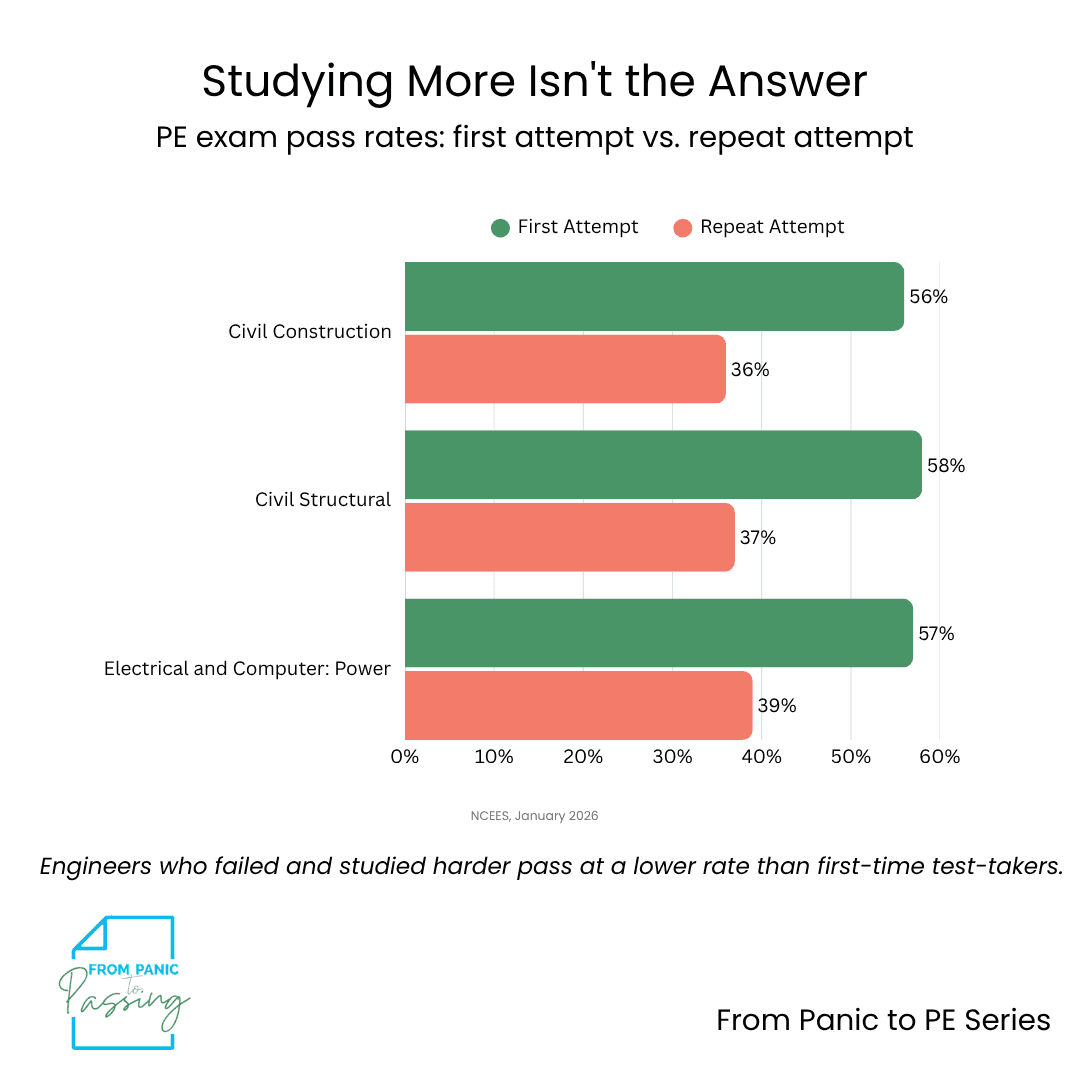
The repeat-failure pattern is pretty universal across exams and disciplines, although I’m not sure that softens the blow at all. I think it is so shocking because it is the opposite of what we learn in school. Study hard, and you will pass. Your effort is tied to your score. You didn’t do well on the math test? Let’s pull you out of class and give you more problems of the same type you got wrong on the exam, because if you do enough practice, your test score will increase.
If all of this was true, then the repeat-failure pattern would not hold! The data shows that you are more likely to fail the exam if you failed it once (or twice, or nine times) in the past. This is so frustrating because engineers are great students. We had to be! And not only were we good students, our degrees are basically degrees in problem solving!
But this is where you might need to give yourself some grace because YOU are not a bad student. You are just doing what you’ve always done and what has worked for you in the past. The thing is that this test has a different kind of pressure with it, so only using the tools you have used in the past could just be what is wrong. If everything you have done before could close this gap, it would have already. Something else is going on, and that is what the rest of this post is about.
Three Gaps That Cost Engineers the PE
After 20+ years of working with high-stakes test-takers, when a smart, prepared engineer fails, the issue almost always lives in one of three places.
The knowledge gap.
It is an exam, so there is going to be information that you need to know and most likely, a few areas that you will need to brush up on. There is a reason the questions are difficult, and you are being stretched to demonstrate your understanding and application of what is being tested. One area that I find is often overlooked when it comes to a knowledge gap is trying to figure out why your answer is wrong versus trying to memorize what the right answer is.
The strategy gap.
Most of us were never taught how to take tests strategically; you were just expected to figure it out. Test-taking is a learnable skill, and as I mentioned already, you are most likely a good test taker (as evidenced with surviving engineering undergrad!). The PE is most likely different from exams you have taken in the past. It is very long and boring, so pacing and focus are important. Thinking strategically during an exam involves thoughts like: How can I use my answers? Am I sure I'm answering what the question is asking? How should I manage my time? None of the testing strategy is intelligence; it is technique.
The mindset gap.
This is the big one, and the one almost nobody is teaching engineers to close. This is the freeze, the blank, the spiral, the clock ticking like a voice in your ear, the hand that writes down the wrong given value. It is your nervous system, doing exactly what it evolved to do, at exactly the wrong moment. Studying harder does not fix it. More practice problems and cramming can actually make it worse! And then throw in the compounding issue if you have failed the exam in the past! The spiral starts before the exam, with hours of extra studying squeezed into every corner of your life. During the exam, the spiral can feel like getting stuck between answer choices. And a spiral after the exam looks like questioning your answers on problems you were stuck on or reliving the exam and feeling the pressure all over again. If you have lived inside any of these spirals, you are in good company. They are the norm, not the exception, for engineers preparing for this exam.
Which Pattern Are You?
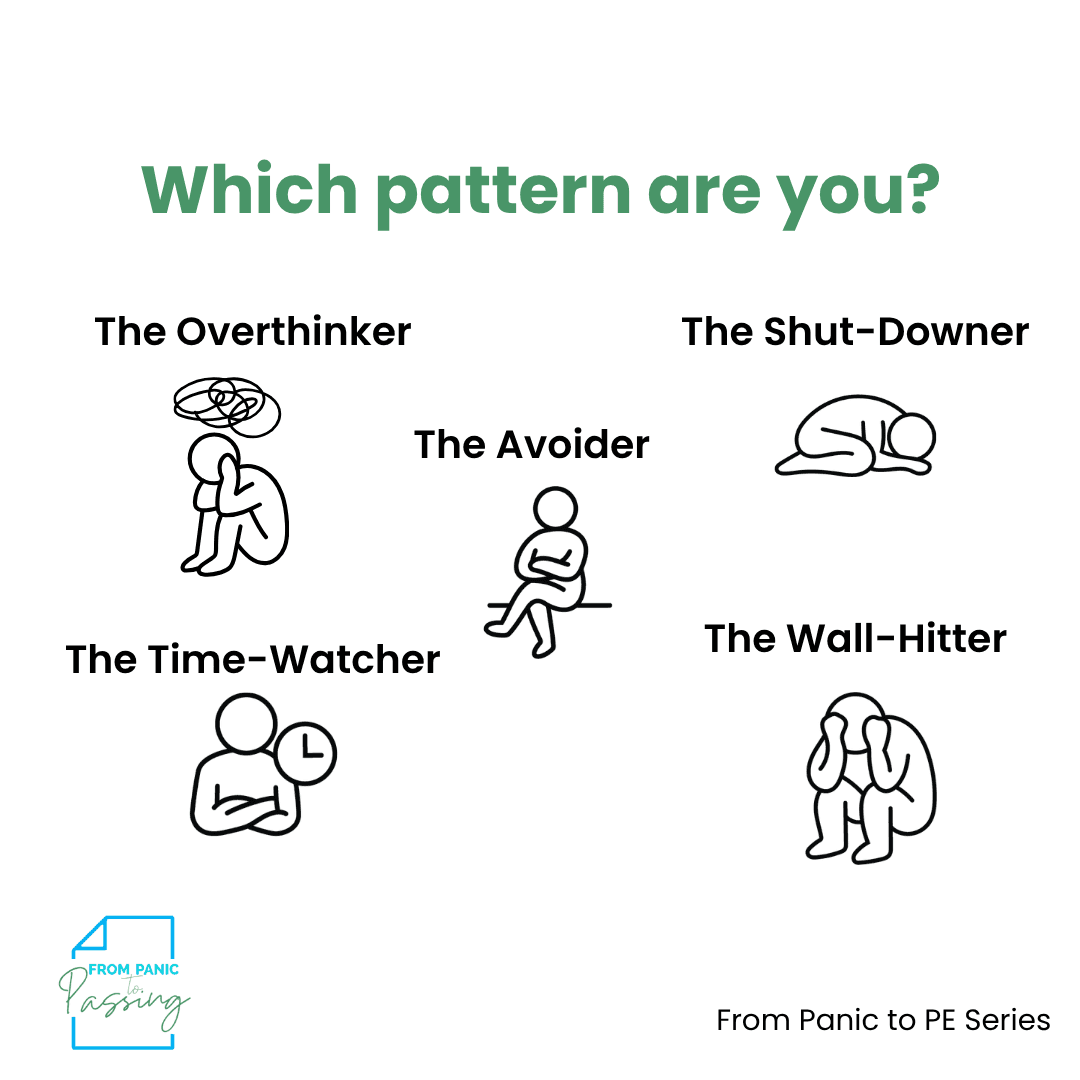
Because I am an engineer myself (University of Michigan, BS in Industrial and Operations Engineering, Class of 1997 - GO BLUE!), I of course look through data for patterns. Engineers who fail the PE almost always fall into one of five patterns, and naming the pattern is the first step to closing it.
The Overthinker. You know the material, think yourself right out of the correct answer, and then you spend the rest of the section second-guessing the answer you already had.
The Shut-Downer. The exam starts, your brain goes blank, and the harder you try to retrieve what you know, the further it slips away.
The Time-Watcher. The clock ticks louder than your own thoughts. Time pressure physically hijacks your thinking, and you start rushing answers you would have gotten right with thirty more seconds.
The Avoider. You want to pass more than anything but cannot make yourself sit down to study, and the longer you wait, the louder the shame grows.
The Wall-Hitter. You have failed before, maybe even more than once. Shame has replaced strategy, and at some point you start to wonder if maybe the people who do not pass were never going to.
If you are reading this and recognizing yourself in one of these patterns, you are not alone. Naming the pattern is the first step. The next five weeks of this series are about closing the gap each pattern reveals.
What's Coming in the Next Five Weeks
This is week one of From Panic to PE, a six-week series aimed at helping you pass your PE, whether this is your first time taking it or your tenth time! The next five weeks will go deeper. We’ll talk about the data of passing the exam. We will take a look at the mindset gap I mentioned above at a much closer level. We will have a guest on the podcast who is an engineer who failed this exam for years before passing. We will also cover the strategy gap, because a game plan will help you walk in more confidently, and the final week will be on what actually closes the loop to passing the exam.
Why even have this series? This series is for the approximately 40% of exam takers who fail their PE the first time, and for the more than 60% of repeat takers. This series exists because too many capable engineers are sitting in shame over an exam outcome that has nothing to do with their competence and everything to do with one preventable thing nobody taught them. This is the part that breaks my heart, the engineers who walk away from this exam thinking they are not cut out for the work, when the issue was never their engineering.
Failing the PE is not a verdict on your engineering. You are not the results of the exam. It is a signal. One of three closeable gaps went unaddressed, and most often it is the gap nobody told you was a gap.
Gaps close. All three of them are learnable. The work is not more grinding. The work is finally addressing the thing that has actually been costing you the points.
I have been having this exact conversation with engineers on the PE Exam subreddit, and the engineers who responded confirmed every piece of what I just told you. If you have failed the PE, you are not broken. You are not less of an engineer. You are someone who has been working on the wrong problem. The next five weeks are about the right one.
If you want the next five weeks delivered straight to your inbox, drop your name and email below. A post lands once a week, and you don't have to remember to come find it. I'll bring it to you.
Continue the series:
➡️ Next post: Why Studying Harder Makes the PE Harder
🎧 Listen to the companion episode: Episode 28
🎓 Ready to go deeper? Check out the full course: From Panic to Passing
Author Bio:
Tina Wiles is a test anxiety expert, high-stakes exam strategist, and Brian Kane Certified Mental Performance Coach with over 20 years of experience helping students and professionals pass high-stakes exams. She is the founder of My2tor and From Panic to Passing. Want the rest of the series? You can have it delivered, one post a week. https://my2tor.kit.com/panictope
In just 60 seconds, you’ll uncover:
Your dominant test-taking mindset
How stress and pressure affect your performance
Why traditional prep hasn’t fully worked
Which strategies will help you feel calmer and more in control
Get expert ACT/SAT updates, strategy tips, timelines, and parent guidance — straight to your inbox.