
by Tina wiles
Late nights. Early mornings. Practice problem after practice problem. Keeping notes on what to review. Post-it notes everywhere with reminders. Investing in a new prep course that you heard has problems that are similar to the ones that you struggle with on the PE.
💡 This post is part of our From Panic to Passing series. If you haven't already, join the free email series for the full mindset + strategy framework delivered straight to your inbox.
This is what you have done in the past when you struggled with material for an exam. You know the areas that you scored low on when you failed the PE, so you are brushing up on those topics. You are asking questions of your peers. You are a great student, and you are 100% committed to dominating this test.
What if everything you’re doing right is actually making it worse?
In last week's post, I showed that repeat test takers pass at lower rates than first-time takers across nearly every PE discipline. That's the data.
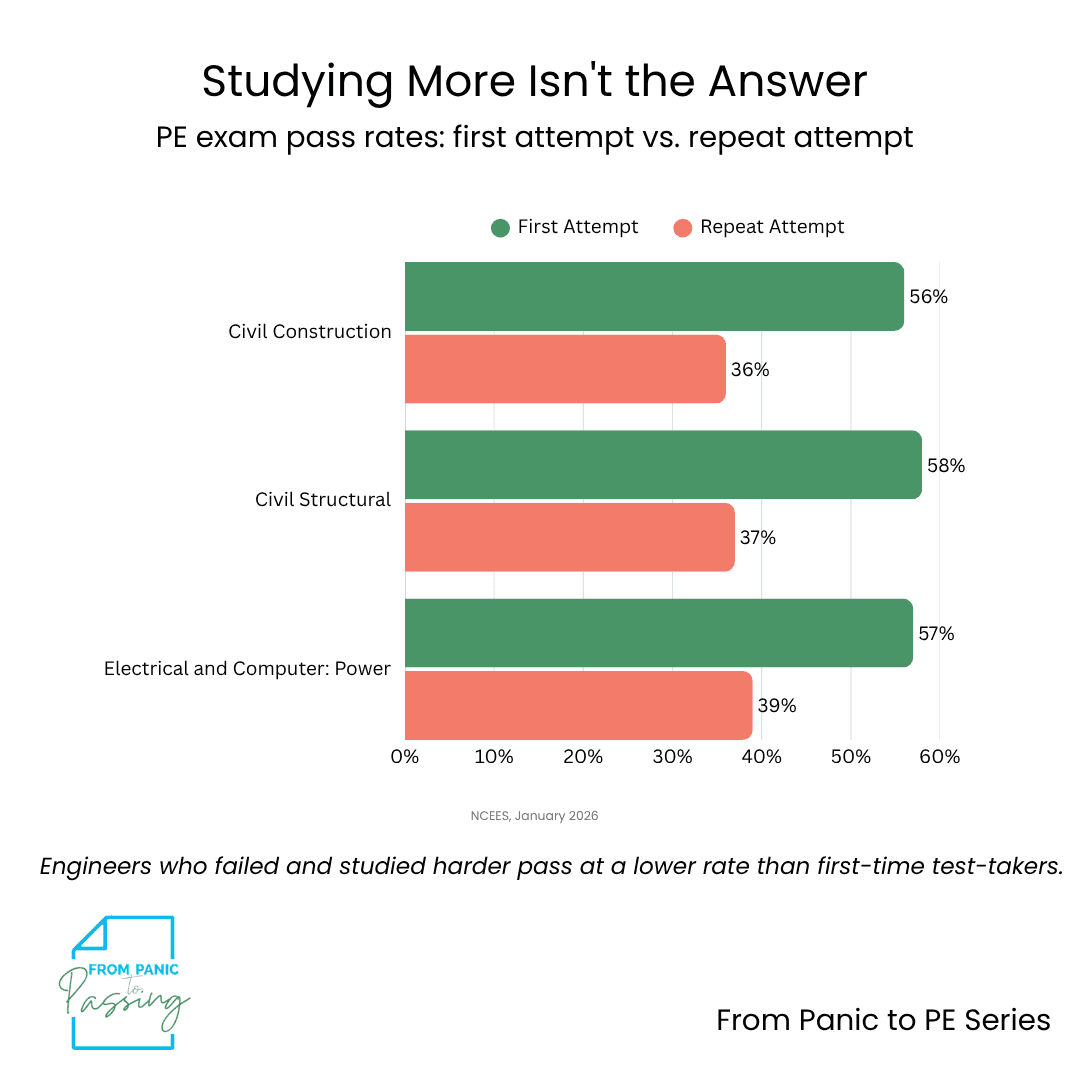
Two things can be true. Yes, some of the gap is selection bias, the engineers who passed the first time are not in the repeat pool, but that does not explain all of it. Something happens to engineers after they fail, and that something is what this post is about.
What happens to your brain
When you fail the PE, NCEES sends you a diagnostic report. It tells you the knowledge areas tested, how many items you got in each, your performance, and how you compared to the average passing examinee. As engineers, we love this. Give us the data.
But, there are things that take place that logic doesn’t apply to: thoughts and feelings.
Three things happen at once.
Sleep gets worse.
Fitting in more study with the same responsibilities means sacrificing sleep or downtime. Both matter. Sleep is when your brain moves what you learned from short-term to long-term memory, and the National Institutes of Health has shown that sleep deprivation reduces activity in the prefrontal cortex, the part of your brain responsible for planning, working memory, and attention. Less sleep means less retention from the studying you just did.
Downtime matters just as much. When you stop focusing, your brain activates something called the Default Mode Network. It feels like doing nothing, but it's actually when your brain consolidates what you learned, connects it to what you already know, and processes the stress of the day. Cutting your downtime to squeeze in more study doesn't give you more learning. It takes away the window your brain needs to lock the learning in.
Anxiety compounds.
The first failure creates a stress baseline that doesn't reset. Every study session now happens with elevated cortisol. Cortisol affects your brain in two ways at the same time. It can help you remember a stressful moment vividly, but it makes it harder to retrieve information you learned in a calmer state. When you sit down on test day with high cortisol, the material you studied calmly is exactly the material your brain has trouble accessing. Chronic stress and long-term cortisol exposure reduces brain plasticity, the ability to create connection between neurons, impairs the brain’s ability to learn new information, and can lead to forgetfulness and brain fog. In other words, more studying with higher cortisol produces less actual learning per hour.
Identity narrows.
Before the failure, "engineer who's preparing for an exam" was one part of your identity. After failing the PE, it can become more dominant. Especially when you have always been a great student, this feeling of failing is a shock to the system. It can come with shame, embarrassment, frustration, sadness, etc. Your self-worth can get attached to the outcome of the test. All of these feelings put an immense amount of additional pressure on the test, and you can unintentionally set yourself up for a freeze response on test day.
These three things stack
The engineer who is studying twice as hard the second time is often learning half as well per hour, with more anxiety attached to the material, and more identity riding on the outcome. The result is a worse test day, not a better one.
These three forces (less rest, more cortisol, narrowing identity) do not affect every engineer the same way. They show up as patterns. The two patterns that show up most often in engineers who failed and are now studying harder are the Shut-Downer and the Wall-Hitter. Lack of sleep shows up most in the Shut-Downer. Anxiety compounding shows up in both. Identity narrowing shows up most in the Wall-Hitter.
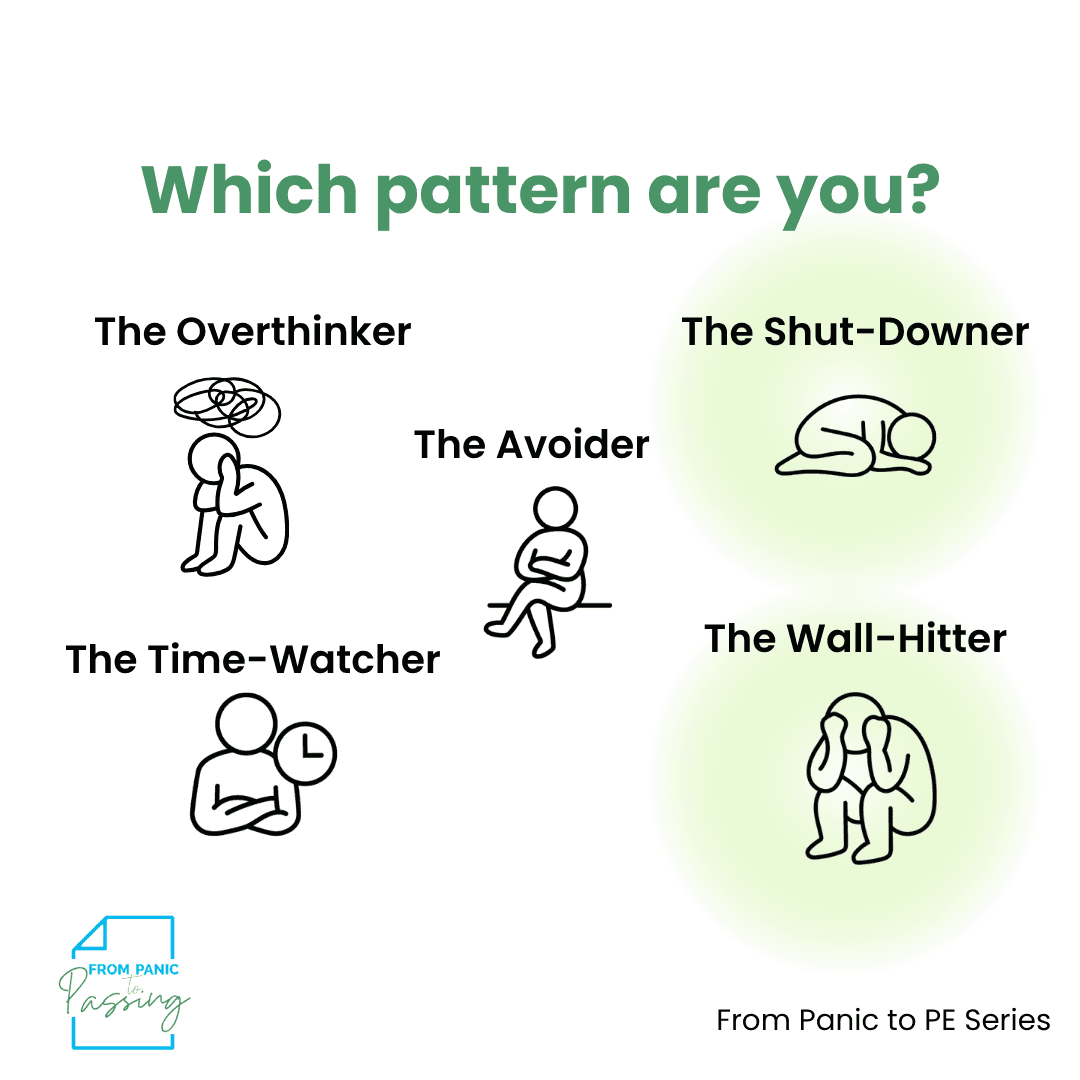
The Shut-Downer
The Shut-Downer is the engineer who walks into the test center feeling unprepared no matter how much they prepared. You blank on questions you know cold. You can answer a question you were stuck on correctly the moment you leave the test center.
When your body has been in chronic preparation stress for months, your sympathetic nervous system gets sensitized. Test day isn't the first time it fires. It's the hundredth. By the time the actual exam starts, your body has been bracing for so long that the bracing itself is the problem.
The harder you studied, the more deeply you sensitized this response. Studying more in this state is not neutral. It is actively building the thing that's about to take you down.
This is why the data shows what it shows. The harder these engineers prepared, the more sensitized their nervous system became. By test day, the preparation itself was the problem.
The Wall-Hitter
The Wall-Hitter is different. This is the engineer who has failed once, maybe twice, maybe more, and is studying not from a place of curiosity or confidence but from a place of "I have to prove I can do this."
The relationship with the material gets lost. The PE becomes a wall to break through: a job title that you desire, a raise that you have been dreaming of, a stamp that has your name on it. It is no longer just an exam and material you need to know.
What's happening underneath is real. When your self-worth fuses with a test result, your brain stops treating the PE as an academic challenge and starts treating it as an identity threat. The amygdala stays activated. Practice problems become evidence: either you got it right, which proves you're capable, or you got it wrong, which confirms you're not. This is exhausting, and it shifts the entire experience of studying. The material is no longer something to learn. It is something to defend yourself against.
Studying can become a punishment. “I didn’t study enough last time, so I am going to study harder than I’ve ever studied in my life.” You can start associating the material with shame and pressure rather than competence and capability.
"If I just suffer enough, I'll deserve to pass." Putting off vacations, or moving to a new place, or not getting that tech toy you’ve had your eye on because you don’t deserve it. These thoughts are not strategy and paying a penance will not help you pass the test!
You cannot study your way out of an identity crisis, and the longer the cycle continues, the deeper the identity becomes.
This is why the data shows what it shows. The harder these engineers studied, the more identity got tangled in the outcome. By test day, the test was no longer about the PE. It was about who they were.
So what should you actually do instead?
Stop asking "how can I study more." Start asking "what does my nervous system need so it does not betray me on test day." Now I’m not saying you don’t need to study; this is a test and that is a given. You still have the data of what knowledge areas are weak. Practice problems are essential, but studying more is not the only thing you should be doing.
Technical things such as being cognizant of the amount and quality of sleep you are getting, working to regulate your nervous system by giving yourself rest, spending intentional time doing mindfulness exercises, and even doing some identity work all don’t feel like you are doing things to prepare for the test. In reality, they are helping you with focus while you study, retaining what you are learning, and enabling you to recall information you need in the moment you need it.
You may also need to pace your test prep differently. What are you doing two months before, one month before, one week before? What does the 48 hours leading up to the exam look like?
The rest of this series will walk through what this actually looks like in practice. How to pace your prep. How to regulate your nervous system. How to do the identity work. And how one engineer who lived this exact cycle finally found the way through.
If you've failed the PE and you've responded by studying harder, you are not making a mistake. You are doing what every engineer was trained to do. The mistake is the training, not you. The next four weeks are about a different way.
Curious which pattern is you? Take the mindset quiz to find out and get a guide for what to do next based on your result.
Want the rest in your inbox? I'll send you one piece a week until we're done. Sign up here.
Continue the series:
⬅️ Previous post: Why Smart Engineers Fail the PE Exam
➡️ Next post: How to Calm PE Exam Anxiety in 10 Seconds
🎧 Listen to the companion episode: Episode 29
🎓 Ready to go deeper? Check out the full course: From Panic to Passing
In just 60 seconds, you’ll uncover:
Your dominant test-taking mindset
How stress and pressure affect your performance
Why traditional prep hasn’t fully worked
Which strategies will help you feel calmer and more in control
Get expert ACT/SAT updates, strategy tips, timelines, and parent guidance — straight to your inbox.