
by Tina Wiles

I have to stop my hand from shaking. I need to hit "Start" to begin my exam, but I'm shaking so much that I have to use both hands to push the button. I have failed this exam in the past. I have spent thousands of dollars and hundreds of hours preparing for this exam, and I'm already thinking about when I take it again because I am positive that I'm going to fail again.
This is how Mel felt as she was getting ready to take the exam that she has been trying to pass for years that she KNOWS will enable her to bring her career to the next level. Changing her job title. Getting a promotion. Getting over the hurdle that has held her back.
Mel thought she needed to study more.
Why wouldn't she feel that way? When we were in high school and didn't do well on an exam, we were told that we needed to study harder!
So how does it feel to hear that it isn't your fault? Studying more isn't always the right answer.
When we are in high-stakes situations, our body triggers a safety mechanism: fight or flight mode. Our body tries to protect us, but at the same time, what is trying to protect us can also be preventing us from recalling information that we know! Anxiety can hijack performance. Studying doesn't fix this!
In over 20 years of working with students preparing for high-stakes exams, these are the reasons I believe smart people fail:
1. Knowledge gap.
It is an exam, so there is going to be information that you need to know and most likely, a few areas that you will need to brush up on. One area that I find is often overlooked when it comes to a knowledge gap is trying to figure out why your answer is wrong versus trying to memorize what the right answer is.
2. Strategy gap.
Most of us were never taught how to take tests strategically; we were just expected to figure it out. Test taking is a skill, so it means that we can improve it! Thinking strategically during an exam involves thoughts like: How can I use my answers? Am I sure I'm answering what the question is asking? How should I manage my time?
3. Mindset gap.
This is the BIG one! Especially if you have struggled in the past, and exponentially so if you have failed this exact exam in the past! You are not the results of the exam. There are things that you can do to turn down the fight or flight response to make it easier to decide between answer choices, to remember knowledge that you have gained through reviewing the materials, and to be able to perform on the actual exam like you do when you are taking practice exams.
So how do you go from "I know I'm going to fail again" to opening the email that says you passed the exam? You need to start off by realizing what the blocks are that are preventing you from achieving your dream of passing this test.
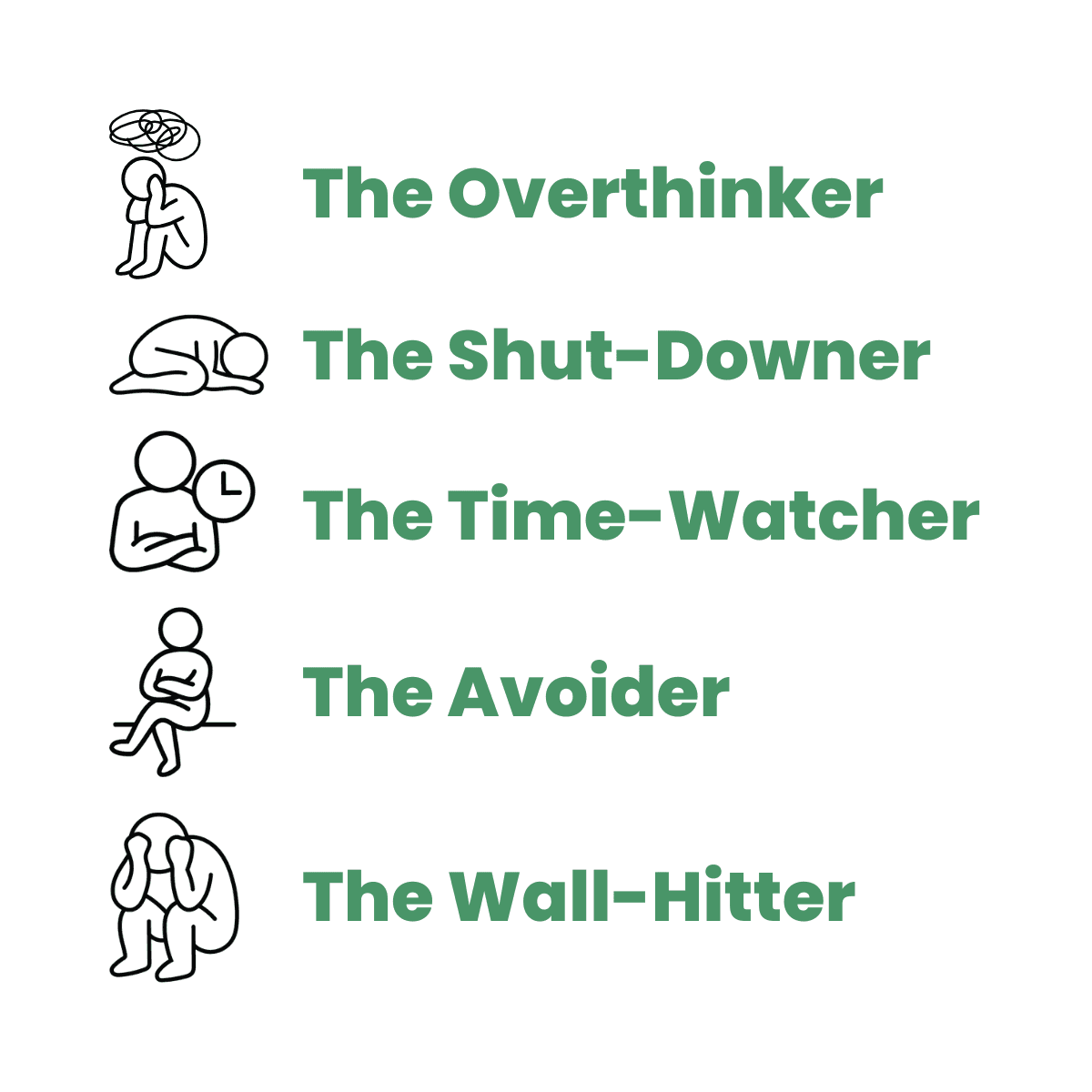
Most people who struggle with high-stakes exams fall into one of these five patterns:
🌀 The Overthinker: You know the material, but you think yourself right out of the correct answer. Your biggest enemy on test day isn't the exam, it's your own mind working against you.
🪫 The Shut-Downer: The moment the test begins, your brain goes blank. Not because you don't know it, but because your nervous system sounds a false alarm. It feels like something is wrong with you, but it's actually your body trying to protect you at exactly the wrong moment.
⏳ The Time-Watcher: The clock becomes louder than your own thoughts, and suddenly you can't access what you know. Time pressure isn't just stressful, it physically hijacks your ability to think clearly.
🛑 The Avoider: You want to pass more than anything, but every time you sit down to study, something stops you. This isn't laziness, it's fear wearing a disguise, and it only gets louder the longer you wait.
🧱 The Wall-Hitter: You've worked hard, maybe failed before, and now shame has replaced strategy. You're not broken, but you need more than more studying. You need someone to help you climb back over the wall.
If you recognize yourself in any of these, you're not alone and you're not stuck!
In less than two minutes, you can take this quiz to help you determine what the main issue could be and to get some ideas how to start working through it.
👉 Test Taker Mindset Quiz | Discover What's Holding You Back
You've got this!
P.S. Mel passed her exam, got the promotion, and is now finding ways to spend the free time that she used to spend studying!
In just 60 seconds, you’ll uncover:
Your dominant test-taking mindset
How stress and pressure affect your performance
Why traditional prep hasn’t fully worked
Which strategies will help you feel calmer and more in control
Get expert ACT/SAT updates, strategy tips, timelines, and parent guidance — straight to your inbox.