
by Tina Wiles

"I failed my exam again."
This thought happens a lot more than anyone admits. Passing rates for high-stakes exams (professional licensure, certification, and school admission tests) often land between 40 and 60%. But the embarrassment, shame, and frustration that come with failing? That part rarely shows up on social media.
For over 20 years, I've worked with individuals and organizations where these exams can mean the difference between living the dream or going back to the drawing board. And in my experience, the content on the exam is almost never the real issue.
That's how From Panic to Passing was born.
It's Not a Knowledge Problem. It's a Performance Problem.
There's a reason the best athletes in the world still miss clutch shots. Michael Jordan (the GOAT, and yes, I grew up in Chicago during the Bulls dynasty, so I'm biased) said it best:
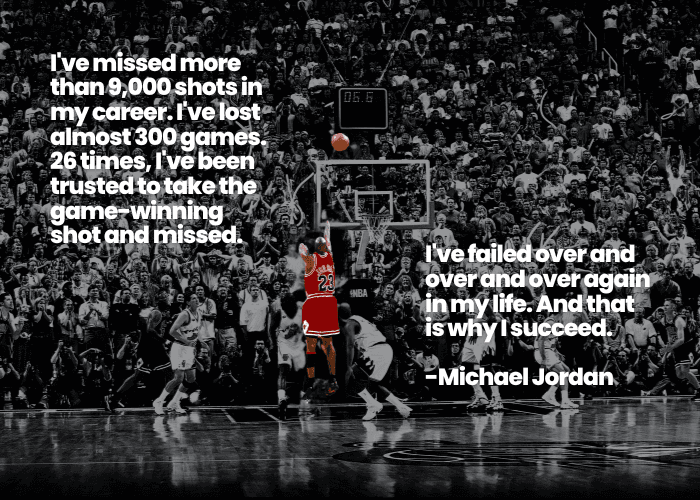
"I've missed more than 9,000 shots in my career. I've lost almost 300 games. 26 times, I've been trusted to take the game-winning shot and missed. I've failed over and over and over again in my life. And that is why I succeed."
We don't hear about the misses. We only see the highlight reel. And the same is true for everyone quietly struggling to pass a high-stakes exam.
Passing isn't just about knowing the material. It's about being able to access what you know under pressure. That's mental performance: the ability to manage your attention and energy when it counts most. It's actually why I pursued my mental performance certification through the Brian Kane program. The parallels between what athletes experience in high-pressure moments and what test takers experience when everything is on the line are striking.
The From Panic to Passing framework is built on two pillars: mindset and strategy. Here's what each one actually means in practice.
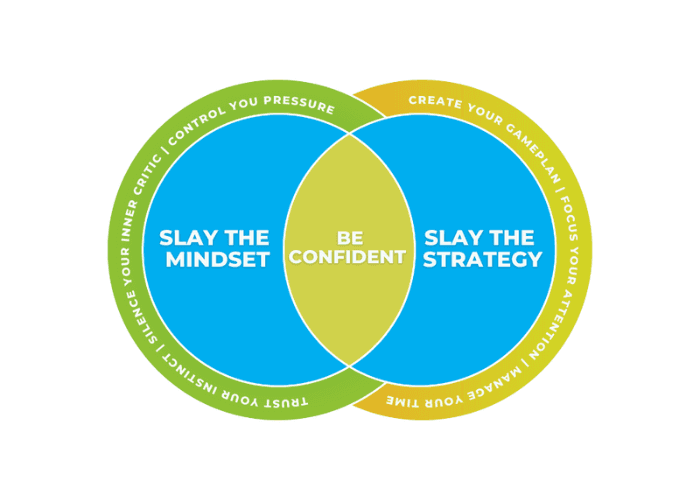
Pillar 1: Slay the Mindset
The science is clear. Your mindset matters when it comes to testing. Your mindset describes your thought patterns and your state of mind. It might sound abstract, but here's the key insight: test anxiety is controlled by thoughts, and you have the power to change those thoughts.
In fact, you can fail your test before you ever walk in to take it. That's how powerful mindset is.
Understand what's happening in your body.
You've probably heard of fight-or-flight (or fight/flight/freeze). It's your body's basic response to stress, and it gets triggered in testing situations. When that happens, stress hormones like cortisol and adrenaline flood your body, and your brain literally shifts from "doing what I need to do" to "making sure we survive." That's why you blank on material you know you studied. Your brain isn't broken. It's protecting you. The problem is that survival mode and test-taking mode don't coexist well.
You can't always stop fight-or-flight from starting. But you can learn to move through it faster.
Trust your instinct.
Here's something that might surprise you: your gut is lined with more than 100 million nerve cells, more than the spinal cord or peripheral nervous system. And about 90% of the fibers in the vagus nerve carry information from the gut to the brain, not the other way around. Your gut is literally sending data to your brain.
This matters because activating the vagus nerve is the fastest way to signal to your body that you are safe, and that you can come out of fight-or-flight mode. Learning to trust your instinct and reconnect to that signal during a test helps you make decisions faster and with more confidence. It's one of the most underrated tools in test-taking.
Silence your inner critic.
Everyone has negative self-talk. The issue isn't that it exists. It's when the negative thoughts outpace the positive ones, or when they cycle on a loop during the test.
I'm going to fail. Why should I even bother? I always get these types of questions wrong.
Think about it this way. When you were first learning to drive, you didn't have the radio on. You couldn't. It was too distracting. And even now, when you're trying to navigate somewhere tricky, you probably turn the volume down without thinking about it. That's exactly what we need to do during a test. We need to turn the volume down on the inner critic.
Because when that voice is running in the background, telling you that you're going to fail or that you're running out of time, you cannot focus on what's right in front of you. Your brain has split its attention between the test content and managing those intrusive thoughts. Brains are not built for multitasking. When attention is divided, something has to give.
Control your reaction to pressure.
Picture a professional athlete in the final seconds of a championship game. In the movies, they always make the shot. In real life? Most athletes perform below their capabilities under maximum pressure. That's not weakness. That's human.
High-stakes exams create that same pressure. And while we can't eliminate the pressure, we can control how you react to it. That's the work.
Pillar 2: Slay the Strategy
Test anxiety doesn't just happen during the exam. It starts the moment you think about the exam. The worry builds before you ever sit down. And here's the thing: planning is the antidote to worry.
When things feel out of control, having a concrete plan is one of the most effective ways to reduce anxiety. Research backs this up. But not just any plan. A plan built around your specific stressors.
Build your game plan.
Most people think about a game plan for studying. Fewer think about a game plan for the actual test. Both matter. Your in-exam game plan should answer questions like: What am I going to do when I hit a hard question? How am I going to use the answer choices? How many questions do I need to get right, and what types of questions show up most? How will I use the available tools and software? Knowing your answers to these questions before you sit down changes everything.
A note for the procrastinators.
If you avoid studying or struggle to get started, you've probably been told that the avoidance is causing your test anxiety. But it's often the opposite. Because you have test anxiety, getting started feels impossible. The anxiety comes first.
So instead of forcing it, start smaller. Create a physical environment that feels good to study in. Some people use a specific scent (an essential oil or room spray) as a cue that signals "it's study time." When you smell it, your brain starts to shift into that mode. Small, sensory anchors like this can be surprisingly effective at lowering the activation energy it takes to get started.
Focus your attention.
No matter why you struggle to focus (whether it's a diagnosed condition like ADHD or simply the reality that your exam is two hours or six hours long), one tool helps everyone: staying in the present moment. It's physically impossible to sustain deep focus for that long without support. Building in short mental breaks during the test, and practicing presence during preparation, can extend your focus endurance over time.
Manage your time.
If timing is an issue for you, you already know it. Running out of time on a test is a real and solvable problem. But here's the part people don't always expect: going too fast can be just as problematic. If you fly through the test and have time left over, that might not be a sign you're doing well. It might be a sign you're not reading questions carefully enough. Knowing how to pace yourself (not too slow, not too fast) is sometimes just as important as knowing the content.
The Bottom Line
Failing a high-stakes exam is painful. But you are not alone, and failing is rarely the whole story. In almost every case I've seen, the content isn't the issue. What's missing is a framework for performing under pressure.
Mindset and strategy are learnable skills. And when you develop both, you don't just pass the test. You change your relationship with pressure entirely.
That's what From Panic to Passing is built to do.
Want to know what's getting in your way? Take the free quiz to find your test-taking mindset type and get a personalized roadmap for what to work on first. Test Taker Mindset Quiz | Discover What's Holding You Back
In just 60 seconds, you’ll uncover:
Your dominant test-taking mindset
How stress and pressure affect your performance
Why traditional prep hasn’t fully worked
Which strategies will help you feel calmer and more in control
Get expert ACT/SAT updates, strategy tips, timelines, and parent guidance — straight to your inbox.