
by Tina Wiles
If you made it this far in the series, you know what I’m talking about: freezing when you aren’t sure how to start on a problem, panic when you can’t remember where to find the information for this problem in the reference materials, heaviness in your stomach when you think about getting the results, and the voices in your head about the time and effort your are putting in and what if it ends like it did last time.
💡 This post is part of our From Panic to Passing series. If you haven't already, join the free email series for the full mindset + strategy framework delivered straight to your inbox.
What if you can interrupt any of these feelings in about ten seconds?
So far, we have talked about what happens with your nervous system and how simply studying harder isn’t the complete answer. So now let’s talk about what you can actually do about it!
The mechanism
Our body doesn’t go into survival mode (aka fight-or-flight) as part of a conscious decision on our part. The sympathetic nervous system, which is responsible for activating the fight-or-flight mode to keep us safe, is part of the autonomic nervous system (which just like the name implies is automatic). Part of this survival mode often involves shallow, rapid breathing, and a quick heartbeat to increase the oxygen in your blood naturally. This served an important evolutionary purpose when we were running from predators, but when taking a test, you don’t use that extra oxygen to power your body to run or fight. This leads to an imbalance of oxygen and carbon dioxide in your blood, and as a result, the symptoms of anxiety increase. Since shallow breathing is causing the imbalance, if you can address your breathing, you can impact anxiety symptoms. An overwhelming amount of research has demonstrated how controlling and using your breath can greatly impact levels of anxiety and regain control of situations.
Now, let’s be honest: it may feel silly to concentrate so much on your breath. Your breathing is normally on cruise control, and you don’t really ever think about breathing. This is part of the problem! By breathing with intention, you are taking your breath out of cruise control mode and sending a signal to your nervous system that you are safe and in control. Slow and purposeful breathing is truly a way to hack your brain!
Anchor Breath
The Anchor Breath habit that we are going to establish is called the physiological sigh.
Stanford researchers, including neuroscientist Dr. Andrew Huberman, ran a 2023 study comparing several breathing techniques. The physiological sigh worked best. It produced the biggest improvement in mood and the calmest body, beating both the other techniques and mindfulness meditation.
Step 1. Inhale through your nose deep enough to fill most of your lungs.
Step 2. Now do a second short inhale, also through your nose, to "top-off" the air in your lungs.
Step 3. Then do a slow, complete exhale through your mouth (like you are blowing through a straw).
Step 4. Repeat two more times.
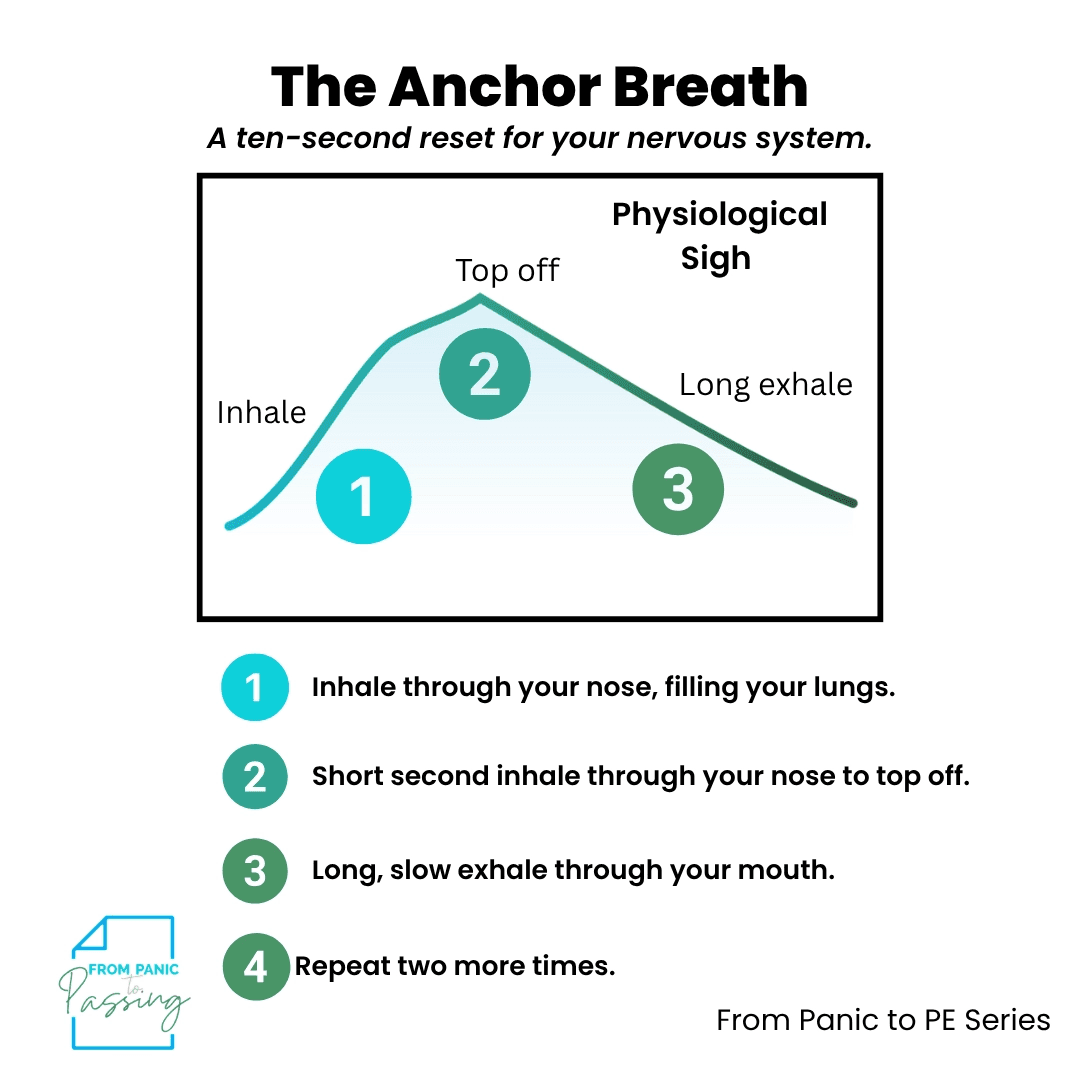
It takes about 10 seconds, and it does 3 things. The double inhale helps to inflate tiny air sacs in your lungs that partially collapse in stressful situations. The long exhale releases built up carbon dioxide in your system from shallow, fast breathing when you are stressed, and the long exhale also stimulates the vagus nerve which signals to your body that it is safe to relax.
One little sigh is doing a lot of heavy lifting!
Protocol
When should you use it? Really, anytime you are feeling stressed, but here are a couple of other ideas:
The night before the test right before you go to bed. The idea is to help yourself drift off into a restful sleep!
Before you walk into the test center. The whole situation can be very intimidating. You have worked hard, you know you have a long day ahead, and taking a few seconds to center yourself before you walk into the test center can help ground you.
Before you push the button to start the exam. Again, recentering after the stress of checking in will help you be in the right frame of mind.
Whenever you feel “stuck” on a question. Do one Anchor Breath and tell yourself “think clearly step by step.”
Expectations
To try to develop the habit of using the Anchor Breath, take something that you already do, such as brushing your teeth or a wind-down routine before bed, and work on practicing the Anchor Breath daily. Practicing the Anchor Breath may feel bizarre because when you are practicing the breath, you are likely not in fight or flight mode. But practicing them now makes them accessible to you during your test. If you don’t practice them now, you won’t remember that you have them as tools when you are sitting in that high-stress situation.
Next week, you will meet a PE who understands all of this first hand. Studying more wasn’t the “thing” that pushed her over the hump of failing the exam over and over again. It started with learning to do exactly what we have been talking about - learning how and when to signal to your nervous system that you are safe and in control.
What now?
Next week you will meet that PE, and her story is the one I most want you to hear. If you are reading this on the blog and do not want to miss it, get the rest of the series delivered straight to your inbox:
And when you are ready to go all in before your next attempt, that is what the full From Panic to Passing program is for. It is backed by The Comeback Guarantee: complete the program, stay engaged, and if you still do not pass, I pay for your retake.
Continue the series:
⬅️ Previous post: Why Studying Harder Makes the PE Harder
➡️ Next post: She Failed the PE Nine Times
🎧 Listen to the companion episode: Episode 30
🎓 Ready to go deeper? Check out the full course: From Panic to Passing
In just 60 seconds, you’ll uncover:
Your dominant test-taking mindset
How stress and pressure affect your performance
Why traditional prep hasn’t fully worked
Which strategies will help you feel calmer and more in control
Get expert ACT/SAT updates, strategy tips, timelines, and parent guidance — straight to your inbox.